- Life as a Knight by Rachael Hanel -- okay, I found one more really interesting book about knights. This is an interactive history adventure, so you get to make choices which affect what happens to the knight. There are three stories in the book, one about a French knight in 1096, one about an English Knight in 1346, and one about a German knight in 1525. All three stories are based on actual events. We had fun with this book.
- Compass and Gunpowder:
- Fantastic Inventions and Inventors by Zhu Kang -- this book is written in comic book style and we quite interesting.
- Bubonic Plague
- The Black Death by Jim Ollhoff -- the information is presented in a way that children can understand
- Bubonic Plague by Jim Whiting is another book written for children
- Joan of Arc
- Joan of Arc by Shana Corey -- I picked up about four books about Joan of Arc that were written for children. They all had good points, but I liked this one best. It is a Step into Reading step 4 book. It has the pronunciations of the French words, which is very helpful.
- Johann Gutenberg -- these three books have a lot of the same information, but they also have different information, so I decided to read all three.
- Gutenberg by Leonard Everett Fisher
- Johann Gutenberg and the Amazing Printing Press by Bruce Koscielniak
- Breaking into Print by Stephen Krensky
- Constantinople
- Istanbul, Once Constantinople by Sue Donovan -- we read pages 7 through 19. It had nice illustrations and easy-to-understand text.
Showing posts with label Middle Ages. Show all posts
Showing posts with label Middle Ages. Show all posts
Monday, October 22
First Grade, History, Set Seven
Resources we used along with Child's History:


Saturday, September 8
First Grade, History, Set Six
Resources we used:
- Look Around a Medieval Castle by Clare Hibbert -- this book takes you on a tour through the Krak des Chevaliers. The Krak is in the present-day country of Syria. It was originally an Arab fortress, the Krak became the headquarters of a holy order of knights called the Knights Hospitalers. I hadn't planned to read any more books about castles, but this one was so well done, with interesting photos, drawings, and descriptions that I decided we need to read one more!
- Crusaders by Joanne Jessop -- this book has great illustrations, easy-to-understand information, and covers crusades from 1095 to 1291
- Ghana, Mali, Songhay by David Armentrout -- we looked at this book a little in the last set of weeks, but this time we are reading the whole thing.
- Ancient West African Kingdoms by Jane Shuter -- After reading the page about the silent trade system between the Berbers and the Wangara (which is all we used this book for) we decided to play it. Now it is a game K. wants to play again and again.
- A Medieval Cathedral by Fiona Macdonald -- tells about how cathedrals were built. It has large and colorful illustrations.
- Early Discoveries by Gerry Bailey -- we used this book to find out more about stained glass windows and we did the craft on page 43 (actually we are still working on them because we are letting the glue dry between adding each color).
- Magna Carta by C. Walter Hodges -- this book isn't really for young children, but it has a lot of drawings and explains the why and how of the Magna Carta simply enough that I could re-word and simplify the concepts so that K. could understand them.
- China by David Armentrout -- this book gives a simple overview of the history of China.
- The Mongols by Robert Nicholson -- this book is more illustration than text, so it is great for young children. It covers from where they live to their homes to their clothes and food and more. In fact, a couple times this week we've read about or someone has mentioned the Gobi Desert and K. lights up right away because she knows where it is.
- The Adventures of Marco Polo by Roger Smalley -- this is a graphic novel and I don't generally like comic style books, but this covered the travels of Marco Polo quite well and kept K.'s attention.
Saturday, July 21
First Grade, History, Set Five
Along with Child's History of the World (chapters 53 - 55), we read:
- Sir Walter Scott's Ivanhoe adapted by Marianna Mayer -- this is a quick read and is meant to introduce young children to Ivanhoe, not as a substitute for the novel. It adheres closely to the original plot, not changing any key details, but certain scenes, subplots, and characters are omitted.
- Robin Hood retold from the Howard Pyle original by John Burrows.
- Castle Diary: the Journal of Tobias Burgess, Page by Richard Platt -- I wasn't sure if K. would be interested in this story, but the first day I read it, she didn't want me to stop.
- Crusaders by Joanne Jessop -- this is a "Beginning History" book
- Ghana, Mali, Songhay by David Armentrout -- this is another book written for younger children, but don't try to cover too much in one day
- Ancient West African Kingdoms by Jane Shuter -- these two books (above) cover the same material, but I felt that the one by Armentrout was easier to understand, but this one has illustrations that explain things better.
Saturday, June 9
First Grade, History, Set Four
In addition to Child's History of the World, we used:
After reading chapter 51:



After reading chapter 51:
- Knights and Castles by Will Osborne -- the is the research guide to the fiction book The Knight at Dawn (which isn't worth reading, in my opinion).
- The Medieval World by Philip Steele -- full of illustrations, text in a large font to read to younger children, lots more information in a small font for children that are older
- A Knight's City by Philip Steele -- a fun book with pop-ups, which give a interactive tour of life in a medieval city. Here is a picture of one pop-up.

After reading chapter 52:
- Illuminations by Jonathan Hunt -- we mostly looked at the pictures
- How to be a Medieval Knight by Fiona Macdonald
- The Middle Ages by Sarah Howarth
- The Days of Knights and Castles by Pierre Miquel
- Adam of the Road by Elizabeth Janet Gray -- about a boy (Adam) that gets separated from his father in 1294 and Adam's travels and (mis)adventures to find his father


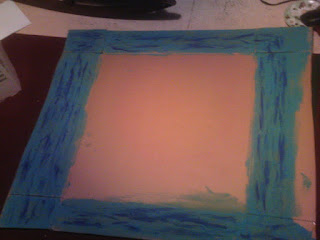
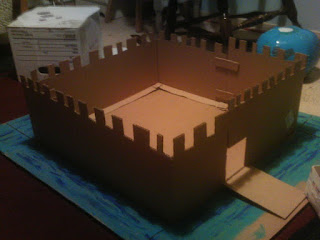
We got the walls painted. (Don't glue the walls together before you paint.) We used sponges to give it a rough look. Inside we have a kitchen, the great hall, and the stables. I used half gallon juice cartons and glued (hot glue worked great) white paper on the outside so K. could paint them. I'm still working on the keep. Since K. isn't old enough to use a knife and cut the buildings, I have found it works better to talk about what buildings we want, then I make them at night and read to her while she paints them. Otherwise, she is sitting there watching me work and getting very tired of the project.


I put a counter along one wall of the kitchen.

There are two tables in the great hall. K. wants to paint the wall yellow with pink dots.

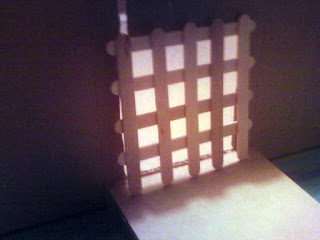
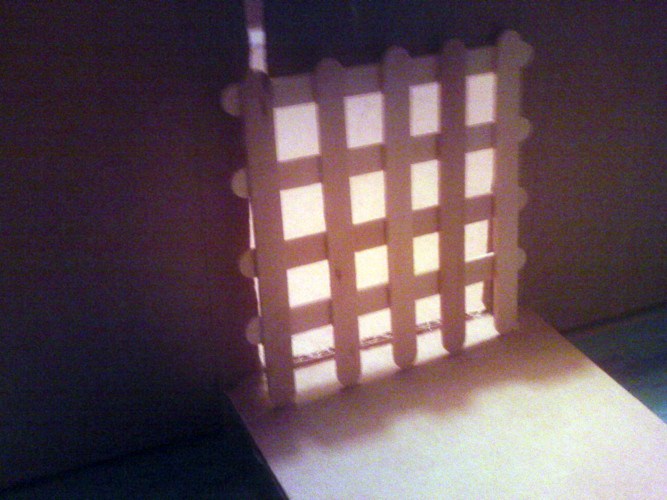
I made this door too big, so it is the stable.
Saturday, April 21
First Grade, History, Set Three
In addition to Child's History of the World, we used:
After reading chapter 48:


After reading chapter 50:
After reading chapter 48:
- Medieval Society by Kay Eastwood -- we took two days to look through this book, mostly reading the bold print and picture captions.
- The Medieval Knights by Louise Park and Timothy Love -- we used this book to look at what knights wore
- The Knight at Dawn by Mary Pope Osborne -- I thought I'd give the Magic Tree House series another try. I've requested the nonfiction study guide for this book. Maybe it will make the book more educational.
- Vikings by Allison Lassieur -- I found some coloring pages of viking boats and such on the intenet and printed them off for K. to color while I read. This book is simple and quick to read, but gives good information.
- Leif Eriksson by Shannon Knudsen -- this is an "On My Own Biography", so uses simple text and full page illustrations
- Technology in the Time of The Vikings by Peter Hicks -- this is another book that we used mostly for looking at pictures, however it has a handful of crafts for children to make.
- This week we made Viking Biscuits pg 11. They turned out okay -- my husband actually liked them -- but while making them, I had the feeling that the person who wrote the recipe didn't make them because the dough didn't act anything like what the recipe said it should be like. This is what ours ended up looking like.

- We made a Viking Longboat out of poster board.

- We sewed a Viking Woman's Cap. (K. really likes this, and has decided to use it for a night cap, wearing it to bed.)

After reading chapter 50:
- Come to the Castle by Linda Ashman -- this book has great illustrations and tells about the jobs of different people who lived in a castle in thirteenth-century England
- The Story of a Castle by John S. Goodall -- this is a picture book traces the life of a typical English castle from the 1170s, when it was built, to the 1970s, when it is opened to the public
- Castle, Abbey, and Town: How People Live in the Middle Ages by Irma Simonton Black -- this book has informative text, but also stories. I read a few paragraphs from the introduction and then the stories to K.
- Knights & Castles: 50 Hands-on Activities to Experience the Middle Ages by Avery Hart -- we made the Rose Petal Bread. I used my own bread recipe and we just painted the tops of the loaves. I made yellow, blue, and green. I divided one egg white into three bowls and added 2 drops of food coloring to each bowl. I would suggest trying red instead of blue because after baking you can't really tell a difference between the green and the blue.
 |
| My loaf |
 |
| K.'s loaf |
 |
| After baking |
Saturday, March 10
First Grade, History, Set Two
In addition to Child's History of the World (chapters 46 and 47) we used:
- We are reading stories from The Arabian Nights. Below is a list of the books I am using.
- I started by reading the chapter "Scheherazade or The Story of These Stories" from Teneggren's.
- Next we are reading Genies. This book has three stories, and puts them in interesting, easily understood language, but it is not a picture book. The stories are divided up into short chapters, so there are good places to stop when it is time for history to be over.
- We finished Genies, and now we are reading The Arabian Nights.
- Teneggren's Golden Tales from the Arabian Nights by Gustaf Tenggren
- Genies, Meanies, and Magic Rings retold by Stephen Mitchell
- The Arabian Nights by Wafa' Tarnowska
- Aladdin and the Wonderful Lamp retold by Andrew Lang
- Tales from the Arabian Nights adapted by Elisabeth Gille
- After reading chapter 47 in Child's History, we looked through these books:
- Education by Alex Woolf -- we looked at the pictures and read a few sentences here and there that I thought would be interesting to her
- Charlemagne and the Early Middle Ages by Miriam Greenblatt -- we mostly just looked at the pictures and read the captions, but this will assuredly be a book we will use when we revisit this era when K. is older
- The World in the Time of Charlemagne by Fiona Macdonald -- here, again, the text of this book is over K.'s head, but the pictures are good
- This week we combined History and Fine Arts and read Moonlight on the Magic Flute by Mary Pope Osborne. This is from the Magic Tree House series. K. really liked the story, but I was disappointed. Although it did teach a bit about that era -- clothing, palaces, queen -- it didn't really teach anything about Mozart, except he traveled with his father and sister and played the clavichord very well.
Last weekend my sister was over to visit. She had something K. wanted to play with. My sister asked, "What are the magic words?" K. looked at her quizzically (we don't use that term) and said, "Open sesame?If you aren't laughing, you need to read Ali Babba and the Forty Thieves.
Saturday, January 28
First Grade, History, Set One
In addition to Child's History of the World, we have used these resources:


- Long, Long Ago by Michael Berenstain -- I used this book our first day to refresh K.'s memory of what we learned last year, and lay the foundation for this year. I did not read the whole book to her, but stopped at the Renaissance.
- The Story of King Arthur and His Knights retold from the Howard Pyle original by Tania Zamorsky
- Life in a Medieval Monastery by Marc Cels -- we mostly looked at the pictures and read the bold writing. We found it interesting that the only had one meal a day during the winter. We decided that we wouldn't have liked that.
- The Two Brothers by Minfong Ho and Saphan Ros -- this is a folk tale from Cambodia
- Pangur Ban by Mary Stolz -- I've started reading this during our family reading time.
- Manners and Customs in the Middle Ages by Marsha Groves -- this book has lots of pictures. If you just look a 2 or 3 pages a day, you can read all the information. After seeing the pictures and reading about the knights, K. wanted to act it out. We also acted out Wedding Customs and Baptism (although, since we are Baptist, we talked about how this does not save a person, but made it more like a ceremony where they name the child).

- The Crafts and Culture of a Medieval Monastery by Joann Jovinelly and Jason Netelkos -- we looked through this book, sometimes reading, sometimes just looking at the pictures and their explanation. Then I let K. pick one craft to do (many were above her skill level, but there were two or three that were easy). She decided we would make pretzels. We had a good time and they tasted good!

- The Barefoot Book of Pirates retold by Richard Walker -- K. really enjoyed hearing all the stories, but the best part (to her) was acting them out after we read them.
Subscribe to:
Posts (Atom)